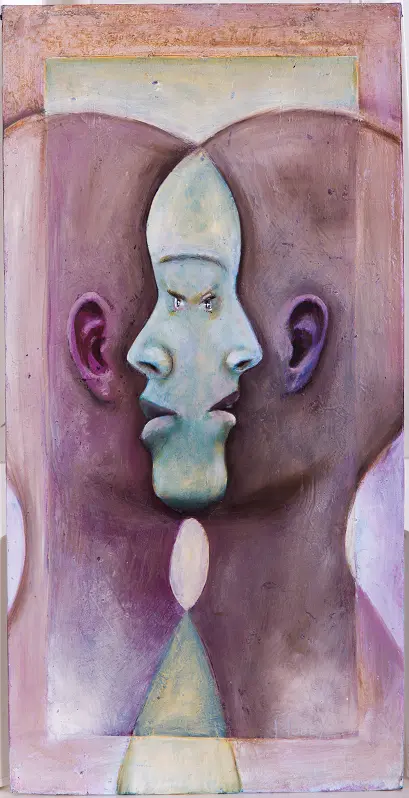
Sanity as Practice
When I was six, we lived in a rented townhouse in Kenilworth that had huge, overgrown ficus creepers and Lilly Pilly hedges almost 2 stories high. One day, the garden service for the block came around to cut everything back, it really upset me since I climbed all over both, but it took them a week and they left the cut branches and detritus of their work over the weekend, so I built a truly enormous (to my 6-year-old-mind) house out of the matted ficus and pole-like berry branches. I still remember the experience of learning how to interlock the flat mats of ficus with the springy lilly pilly branches, and the acid smell of the crushed leaves and berries.
I also have a clear memory of the trouble I got into (many times) for sneaking my dad’s box cutter from his tool case in order to carve little figures out of my mom’s wooden clothes pegs. I was about 8. By the time I was 12 I had scrounged my own carving tools and begun a life-long accidental piercing side-project. This is still my approach to life and art: building with what’s available, with or without the support or sanction of those who claim authority. I’ve come to think of art, and the creative process itself, as a defiant act of sanity in the face of chaos.
My current practice is always too narrow though, even as I add branches: printmaking, writing, music making, metal casting, electronics, programming, house building, fine woodworking, clothing design, interior design, engineering. All of these things can only work through engaging with reality, and I crave full-contact. Full creative agency. Being a maker in every sense. Autodidactism as a value and an approach to my brief existence.
Sanity is a practice of engagement with the world and with your own mind, even when you disagree with what you find there.
I don’t think I have it right. Not yet. The practice is evolving as I learn, and learning itself is the practice. So while I try to turn experiences, ideas and philosophy into art, I realise that this is still a very narrow tool for engaging with reality.
I’ve worked in shared studios with several top artists, mentored several young artists (interns at art schools and graduates alike) and, from our conversations about art schools and the gallery scene, I’m forced to conclude that the art world is full of artists who have arrived at a position and are executing it, regardless of reality. This is actually what many of the art professors unashamedly teach, to the point where students of art are overtly punished for not finding, holding and executing a position (preferably an approved position) in a ritualised way. If they don’t have one, they learn quickly to use “international art English” to word-salad their way into compliant credibility. The whole process is fetishised and incentivised to produce more YBA type thinking, and a “paper-mill” type of art production that mimics the “publish or perish” hole of other academia, with equally unhinged results.
The tragedy is that, because so much transcendent art is created as a rebuke of trauma, some people and institutions mistake some types of pathology for genius, entrenching preformative substitutes by creating systems that require them. Brilliant artists who could have produced profound works, instead learn to produce acceptable work that complies with the fashionable manifestations of pathology.
Furthermore, I think the top of the art market, and therefore academic discussion, is based in the personality disordered fetishisation of the tortured (narcissistic) artist, epitomised by the YBA school, Lucian Freud, Jackson Pollock etc. probably due to the fact that the collector market, and financial power is dominated by a self-selecting group of in-crowd pundits and gatekeepers who strongly relate to the pathology. The fetishisation of some insane artists is very obvious, measurable, and structural:
“Using a unique auction dataset from artinfo.com, we find that narcissism measured by the signatures of artists is positively associated with the market performance of artworks. The artworks of more narcissistic artists have higher market prices, higher estimates from auction houses, and higher outperformance compared to the art market index. In support of this narcissistic view of the market performance of art works, we find that the higher recognition by art experts lead to more narcissistic artists having a greater number of solo and group exhibitions, more museum and gallery holdings, and higher art history rankings. More narcissistic artists also tend to make larger paintings and date their works more frequently.”
Zhou, Yi. (2016). Narcissism and the art market performance. The European Journal of Finance. 23. 1-22. 10.1080/1351847X.2016.1151804
A well understood example is Jeffrey Epstein’s flagrantly corrupt relationships with artists and institutions. We have comprehensive evidence of patronage exchanged for access, artworks used as financial instruments for wealthy clients, cultural credibility deployed as a profitable social cover. Perhaps he was an extreme example of the system, but in no way an exception.
The same concentration of unaccountable private wealth that is currently being prosecuted across multiple countries for broader abuses has always used culture as both a laundering mechanism and a legitimising one.1
“Artists talk darkly about ‘gatekeepers’, as though sinister and mysterious forces policed the art world, keeping them on the wrong side of the wall. I imagine these creatures to be something like the White Walkers from Game of Thrones but wearing Margiela and smelling of Kyoto by Comme des Garçons. The art world is not short of mysterious forces (Hello, nepotism? I’ve got Daddy on line one…). The real secret about gatekeepers, though, is that they depend not on a sinister conspiracy, but on a random and slightly crap combination of gossip, grunt work and gut instinct.”
Hettie Judah, “Don’t fear the gatekeeper” in Apollo Magazine, 25 March 2024
That “gut instinct" feels a lot like recognising the right type of pathology. The “cool” type. The type that oligarchs relate to. Especially in the upper echelons of collectors and dealers, where bananas are sold for millions, the people with the most power in this system didn’t get there through merit or ethical behaviour, but through money, through each other, and through a shared interest in reinforcing the status quo. Many have demonstrated, repeatedly and publicly, that art is little more than, at best, a virtue signal or financial instrument to them. The “in joke” is what sells, and the joke is most definitely on us. To that specific, admired group, the only art that gets validated, collected and taught is the art that serves that system’s self-image.
It really doesn’t have to be this way and there are exceptions who prove the rule: Olafur Eliasson resonates, especially his diverse, dynamic and multi-disciplinary studio mode, and his explicit commitment to engagement with the world as he finds it. I would be delighted with a life that produced as much as he has. The local artist named Pablo Atchugarry too: his creation of the Maca Museo is a lifetime achievement in itself, and enables other artists to create in a way that distributes creative agency across many minds and lives.
I really aspire to creating on the scale of both. I lack rootedness, commitment to place. That’s not a luxury I have ever had, so Atchugarry is aspirational in a different sense than Eliasson. So much of my work is about home, migration and being migrant, even in the country of my birth. The freedom to actually create at the scale and scope of Eliasson requires a degree of stability, a creative home for the act of making. So they are paths to each other.
Given the sort of creative agency I aspire to, I’d probably build a school that undoes the damage of the current art school model. The dream would be to include engineering, science, and systems thinking at its core, as well as the technical mastery required to make art that doesn’t fall apart in a decade or two, unless the artist wants it to (looking at you, Anselm Kiefer). Art would be a result of teaching the ability to learn.
I can imagine a school that would teach engagement rather than position-holding, inquiry rather than approved execution, making as thinking rather than papermill production. Most art schools advertise as if they did this. Most really don’t. They benefit artists mostly by introducing them to useful people in the art world, who met each other in similar ways. It’s pretty incestuous and the results impoverish us all.
-
Harvard International Law Journal, “Fighting Money Laundering in the Art Market” (2025). https://journals.law.harvard.edu/ilj/2025/03/fighting-money-laundering-in-the-art-market-a-comparative-overview-of-u-s-and-swiss-law/ ↩︎